
MORSE
A House of Stewardship
A House of Stewardship
Core Mission
“Ownership is a legal condition. Stewardship is a moral one.”
Morse exists to preserve and transmit the capabilities that make stewardship possible — through vessels, through the people who care for them, and through the record they leave behind.
Underway Now
Morse Apprentice is a DeFever 41 running a Ford Lehman 135. She is the operating laboratory of the house. Every checklist, naming convention, archive practice and standard Morse publishes is worked out aboard her first and revised through use before it is offered to anyone else.
Phase one is not beautification. It is trustworthiness — through-hulls, seacocks, hoses, bilges, high-water alarms, batteries, electrical condition, engines, generator, fire systems, sanitation, water, ventilation, safety equipment, and a baseline record of all of it. A beautiful vessel with uncertain critical systems is not yet a stewarded vessel.
What Apprentice must teach
Apprentice is the operating laboratory. Everything else should earn activation.
Foundational Principles
Stewardship over ownership.The title is paperwork. The duty is the point.
Preserve what is irreplaceable.Some things, once lost, do not return.
Restore without sacrificing identity.Improve what can be improved. Keep the soul intact.
Transform only for the long term.Change is permitted where it strengthens stewardship.
Destinations are milestones.Stewardship is the journey between them.
Relationships before transactions.The house deals in decades, not closings.
Excellence through apprenticeship.Skill is transmitted hand to hand, or not at all.
Long-term thinking over short-term optimization.We do not trade the hull for the quarter.
Documentation is part of stewardship.An undocumented vessel is an unfinished duty.
Every vessel carries her own biography.Where she has been, and who kept her, is part of what she is.
Doctrine
Morse is a house of stewardship for both vessels and people. It intentionally creates collisions between accomplished individuals from different disciplines, so wisdom, judgment, and capability are transmitted across domains. Six standards govern how the house decides. Every significant decision then ends in the same fourteen questions.
Cost is not quality. Exceptional materials belong where they measurably improve durability, repairability, or meaning. Economical materials are excellent when proportion and workmanship make them so.
A vessel should inspire confidence before admiration. Trustworthy, then capable, then comfortable, then beautiful — in that order, without exception.
Morse is not anti-technology. Morse is anti-unnecessary dependency. Technology serves the steward; the steward never becomes captive to it.
A well-stewarded system should fail small, not fail everything. Redundancy is strategic rather than indiscriminate — complexity added only to provide redundancy becomes its own failure source.
Critical systems stay understandable, accessible, diagnosable, isolatable, repairable and documented — sized for an engaged owner, not a full-time engineering department.
We do not seek exclusivity. We seek alignment. A meaningful standard must be willing to decline work: it is the business Morse does not do that helps define Morse.
The Morse Question
Vessel Stewardship
A vessel without her record is a stranger. Each Morse vessel maintains a permanent dossier — the living biography that travels with her from steward to steward.
Attestation Framework
Morse resists collapsing a vessel into one number or one tier. Four independent dimensions are assessed, and they are only meaningful read together.
The nature and depth of the stewardship work actually performed — stated plainly, never implied by the score beside it.
Condition, supportability, serviceability, documentation, safety and failure resilience — assessed without reference to any particular owner.
Individual to the intended use. A boat can only be a 93 relative to a mission; one steward’s 93 is another steward’s 78.
The owner’s side of the relationship. Passive ownership is incompatible with stewardship, whatever the vessel scores.
A vessel is assessed against the way she is meant to be used. Mission classes describe that use — they are not status levels and they do not rank against one another.
Provisional
The mission determines the architecture. The architecture does not determine the mission.
An attestation describes how stewardable, understood, supportable, documented, mission-aligned and ready a vessel is. It does not imply perfection, and it does not replace survey, mechanical inspection, engineering, classification, legal compliance, or insurance requirements.
The standard is being written against Vessel 0001, and validated on outside vessels, before it is offered to anyone else.
Archive Philosophy
Memory is a maintenance item. Morse preserves it in three forms, so no vessel’s knowledge dies with a single owner.
A permanent waterproof archival chest travels with every vessel — her papers, artifacts, and provenance, physically aboard.
A working stewardship binder for the current steward: live records, service notes, and the season’s log.
A mirrored digital record preserving the full dossier beyond any single hull, harbor, or hand.
The Stewardship Library
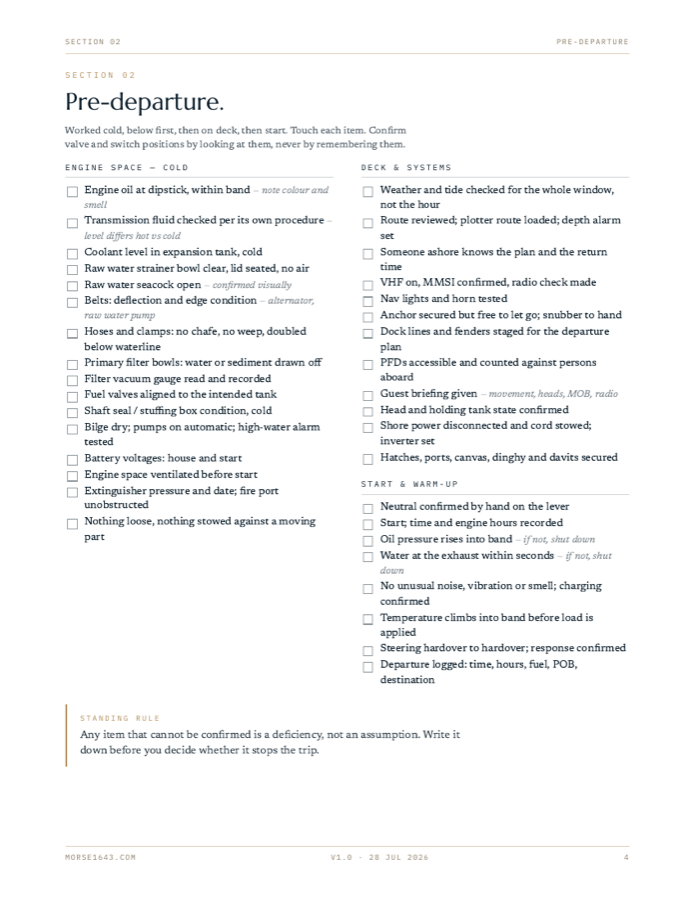
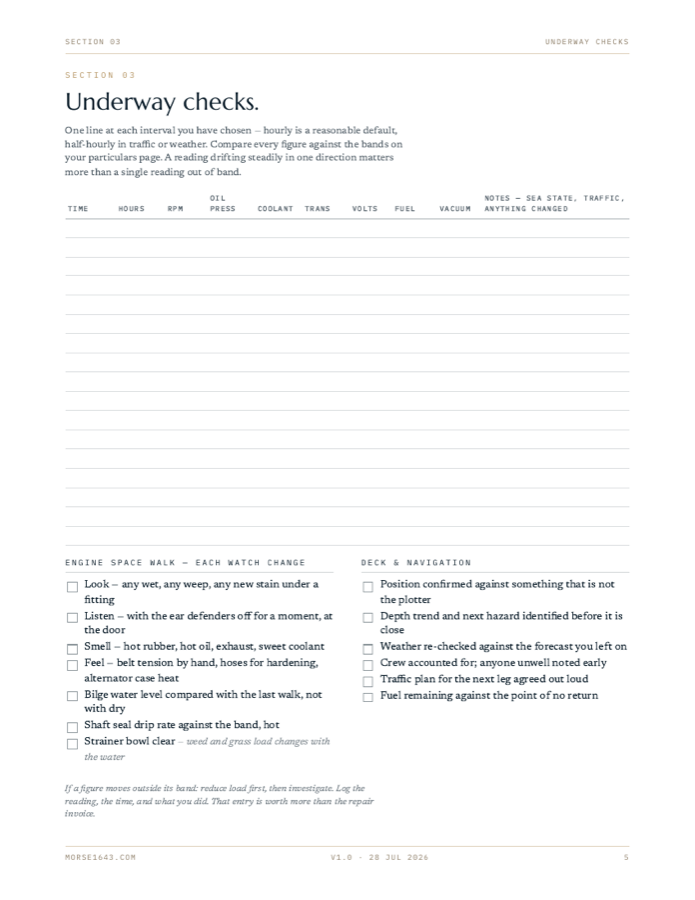
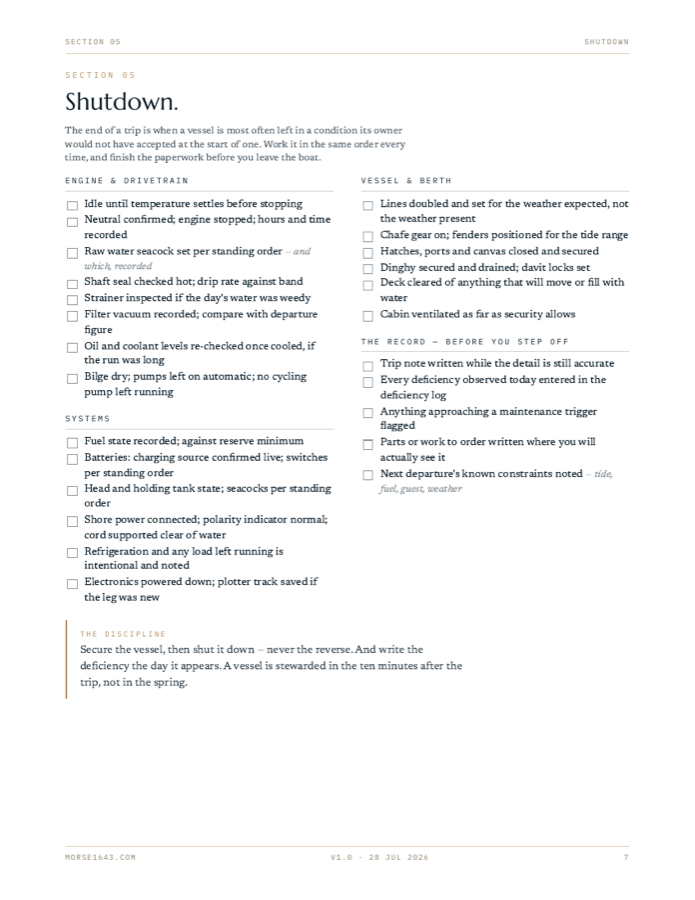
A practical set of vessel-operation checklists for owners building deliberate, documented habits aboard.
Free · No email required
Print-ready and ready to go aboard. Pre-departure, underway checks, docking approach, shutdown, and trip notes — nine pages, made to be printed, marked up, and kept at the helm.
Download the Starter EditionEditable · By request
The working spreadsheet behind the logbook: vessel customization, your own operating standards, a trip log, a maintenance trigger table, and a deficiency log — built to be adapted to one specific boat. Excel, and imports into Google Sheets.
Request the Editable PackMorse created this logbook to help vessel owners replace informal memory with repeatable habits, written checks, and an improving record of care. It is offered as a public stewardship resource and a starting point for owners to adapt to their own vessels.
It does not tell you what your readings should be. It asks you to establish what normal looks like on your own vessel, write it down once, and check every run against that record. A gauge reading means nothing in isolation. The same reading, logged forty times, tells you when something has begun to change.
This is a general organizational framework, not a substitute for manufacturer instructions, professional training, vessel-specific procedures, or the judgment of a qualified captain.
Version 1.0 · Revised 28 July 2026 · Corrections to helm@morse1643.com
The logbook is the first artifact in the Morse Stewardship Library. Handover worksheets, guest safety briefings, seasonal lay-up procedures, spares inventories, and sea-trial forms follow — each released free where it should be useful, versioned, dated, and open to correction. Tell us when the next one is published.
First Stewardship Product
Coming Soon
The first product of the house does what the house does: it protects what is irreplaceable. The MEG closes over the belts and pulleys of a running engine — sliding into slots fixed to the engine itself, held fast by spring bolts: off in seconds for service, immovable underway. Perforated for cooling air. Cut with the mark of the house — or the steward’s own letter.
Built to protect. Built to last.
The House Speaks in Code
The bezel of our seal, the head of every dossier, the foot of every invitation — each carries a line of Morse. Read the ring of the seal, letter by letter, and it says a single word.
Learn the marks, and the house begins to speak to you.
Future Vision
Morse ultimately becomes a self-sustaining ecosystem dedicated to preserving maritime capability and craftsmanship: